
I don’t know about you, but while our formerly thrifty board’s recent decision to buy increasingly young players for fees in excess of £30m is makes me happy, it also makes me wonder: Is this for real? Are we set to emulate clubs like Brighton and Brentford and become a buying-and-selling Premier League powerhouse with an even bigger budget for getting new players?
I believe the answer is yes to the former, but no the latter.
Because of the Premier League’s new Squad Cost Ratio (SCR) salary rules, we are instead buying younger, slightly more expensive players that we can sell on so we can keep on buying enough talent to stay competitive in the Premier league.
We have to do this because we’re already over the SCR limits and have to find new ways to generate revenue. And, unfortunately Fulham will have to do so with a budget that is – relative to the club’s revenues – smaller, not larger.
The trend
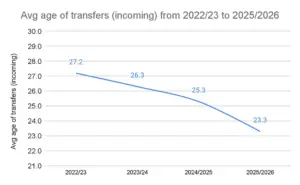
Looking at incoming transfers over the past few years (and what is changing), one thing stands out: our transfers are clearly getting younger, more expensive on average – and fewer.
The average age of incomings has gone from an average age of 27.2 years old in 2022/23 to just 23.3 years in 25/2026.
Data source: Transfermarkt
And, we are, on average, spending more for the younger players.
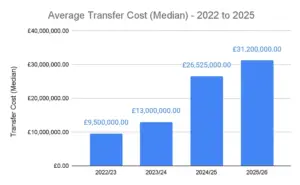
Date source: Transfermarkt. Note, I used “median” for average so the very small transfers we did in some seasons (for Benda and Lecomte) don’t overwhelm the average. The same trend, while less stark, occurs with using a “mean” average.
And while our average cost per player is going up, we are – with the exception of the 2024/25 season when we were able to sell Palhinha and Stansfield – spending about the same same amount per year on transfers.
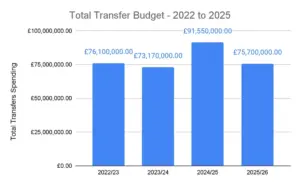
Data source: Transfermarkt
Because we are spending more with – essentially – the same transfer budget we are buying fewer players every season.
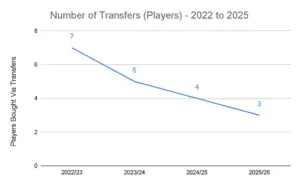
Data source: Transfermarkt
So, Fulham is essentially now making fewer, younger, and more expensive bets with our transfer approach. And we are doing this because of these new spending rules about to come into force for the Premier League, which are putting pressure on clubs to spend less and to buy players that can be resold (so they can generate more revenue).
SCR: the new spending cap
Last November, the Premier League voted to adopt SCR to replace the profit sustainability rules (PSR).
Fulham voted against putting these rules in place because they put the club at an even greater competitive disadvantage than the old ones. But, the club and its allies lost, and SCR was voted in by a majority. They will go into effect next season.
SCR essentially simplifies the spending cap, which was formerly much more complicated under the multi-year PSR. Now, it is essentially a club’s spending on salaries and transfers as a percentage (or ratio) of their revenues for a single year. As the Premier League describes in its Q&A about the new rules:
Squad Cost Ratio limits Premier League clubs’ on-pitch spending to 85% of their football-related revenue and net profit/loss from player sales…Squad costs cover player and head coach wages, agents’ fees and amortisation or impairment of transfer fees… football-related revenue encompasses both the income that clubs generate themselves and the revenues distributed by the League and other football competitions.
The problem for Fulham is that SCR limits the costs the club can manage to essentially salaries and transfer fees, while also limiting what is defined as football revenue to be commercial revenues, matchday revenues and net profits from non-football events hosted at their stadiums, such as concerts.
As we all know, Fulham is a club with limited options for generating more football-related revenue because of our size, And it doesn’t look like the club will be able to count revenue from its fancy new restaurant, hotel or other non-matchday related efforts, unless they can somehow prove they are tied to matchday revenue.
Can we spend more with SCR limits?
I know many of us are thrilled with the club buying younger and talented players like Oscar Bobb, Kevin and ESR, and want more. Retain Harry! Make Chuk permanent! Go get Pepi!
The problem is that Fulham, according to The Athletic, are already in the new SCR red zone, with an estimated squad cost ratio of 91% for this season.
What happens when you are in the red zone? Initially, not much. Clubs are allowed to spend up to 115% of revenues before they face sporting sanctions (a six-point penalty plus another point for every £6.5m over the spending limits). Clubs just get fined 5% of the amount they go over the 85% (around £500,000 for us, give or take).
But, for every year the club goes over, the extra margin the clubs get to play with gets reduced by the amount the club went over the year before. So, if Fulham stays at 91% this would mean that the maximum the club could spend the next year would be 109% (or 115% minus the 6% the Club is already over the 85% threshold). If you don’t lower costs and keep on going over, the cushion gets smaller and smaller until you – pretty quickly – run into trouble.
Still with me? Good. I ran the numbers and the club could keep its current spending level (91%) for about four years before it would cross the final red line and face sporting sanctions.
But, let’s say we do retain Harry, make Chuk permanent, get Pepi in, and maybe even get that midfielder that Marco wants, while keeping everything else roughly the same (in terms of spending). This would push the Club towards 100% in terms of costs versus revenues.
The club could spend 100% for two seasons before going over the red zone and facing sporting sanctions. The math is not that hard: going to 100% one year would mean that the club would lose 15% of the cushion the following year (115% minus 100%) which brings the danger line to 100% percent, from 15%, the following season.
Sell more to spend more
The Club needs to bring in transfers that it can – hopefully – sell later on to recoup that initial investment and find a way to bring total costs down. Under the rules, clubs will need to factor in the salary paid players plus the amount of transfer fees needed to buy that player that the club will assign to the year in question.
This is called amortization (an accounting term). For example, Fulham paid Shakhtar Donetsk £40m for Kevin and then signed him to a five-year contract. So, the club would, if it is amortizing this fee over the five-year contract equally each year, assign the equivalent of £8m of the transfer fee to its SCR costs every year.
In addition, the football financial site Capology estimates that Kevin gets paid £2.6m per year. This would bring the total costs for Kevin to £10.6m per year in terms of counting for SCR (£8m in transfer fees plus £2.6m in salary).
The benefit of Kevin, versus say Willian, who we paid nearly £5m in salary when we first signed him in 2022, is that we can pay Kevin a lot less in terms of salary and, unlike Willian who was 35 when we got him, we can probably sell Kevin for the same or hopefully more money down the road
Many fans, myself included, tend to place too much weight on the importance of transfer fees to spending caps. In reality, salaries are more significant in terms of costs. In 2021/22, Premier League clubs spent an aggregate of £3.6bn (or 66%) on wages and £1.85bn (or 34%) on transfer fees.
The problem is that – going forward – we will need to sell players to get the money we need to buy new players. And, we will need to avoid paying big transfer fees for older players that we likely won’t be able to sell – unless we can somehow pull off another Palhinha.
The case for Harry and against Samu
While signing Wilson for more money is problematic because we are essentially replacing Harry with Harry, but spending several million more to keep him (and making our cost and SCR situation worse), the good thing about re-signing the Welsh winger is that we don’t need to pay a transfer fee to keep him. And, it may be difficult to find the money to replace him with an equivalent talent who can score goals and make assists at the same rate.
Unfortunately, the problem with Chukwueze is that he is already expensive; he makes an estimated £6.2m a year according to Capology and will require Fulham also spending – according to press reports – another £22m to 26m in transfer fees to exercise the loan option from Milan. All things considered, that would make him most expensive player on the squad (in terms of SCR) – and he’d be 27 years old.
Where does the profit lie?
While we can hope that Kevin and Bobb come good and we can make a healthy profit on them both, that does not seem likely to happen in the near future. Kevin, for example, is now worth £30m pounds according to Transfermarkt (or £10 million less that what we paid for him).
So, what players would bring the most profit to Fulham if we sell?

It’s important to note that Fulham has a the option of an extra year on Calvin Bassey. This means that while he has only one year left on his contract, the club has effective control for two more seasons.
The other player with a lot of surplus value is Ryan Sessegnon, who is valued at £20m by Transfermarkt and who the club got on a free. His contract, unfortunately, expires at the end of this year. There is an option for next year, but it’s not clear if it is controlled by the club. I am assuming this will make it hard for Fulham to be able to sell him.
The other player not on this list who might have real value is Jorge Cuenca, who Fulham are paying an estimated £1.3m a year (and for whom we paid only £6.7m in 2024). Right now, Transfermarkt says he is worth only £4m but if he keeps on starting hopefully this value will go up.
The new rules exclude any costs related to the academy, but allow the club to count revenues gained from academy sales. So, selling Josh King – and potentially other stars like Seth Ridgeon – at the right time will help the club a lot under SCR.
The club could also look to move on from Bernd Leno, and potentially Joachim Andersen, and replace our two-headed monster ‘keeper with a shot-stopper who is good with his feet (and hopefully a lot more affordable). The two, together, cost Fulham more than £18m this season (or about 13% of our wage bill). The problem is that Andersen is under contract until 2029 and Leno until the end of 2027.
Why not go for more Rodrigos and fewer Bobbs?
The club’s greatest success in terms of acquiring younger players is arguably Rodrigo Muniz. We paid Flamengo just £8m for him in 2021 when he was a 20-year-old back-up striker. Four years later and he’s now worth £25m, according to Transfermarkt.
Since then, Fulham has rarely scouted and tried to recruit unproven, younger and more affordable players further down the food chain, which has been the key to Brighton’s and Brentford’s success.
Instead, we seem to be increasingly relying on other clubs to do the scouting work for us (like Manchester City or Shaktar). While I wish we could be more like Brighton, in reality, even Brighton is becoming less like Brighton these days and is also targeting more players in the £30m to £40m bracket as the competition for finding the next Alexis Mac Allister increases.
Also, it could be argued that our transfer strategy – like how we found Rodrigo – is very dependent on Marco Silva. He is also the guy who found the biggest recent transfer win in the form of João Palhinha (who seems more and more like an anomaly in terms of age and success in being able to resell).
A word on impairment
Because of SCR, I assume the club will also become increasingly aggressive in using impairment to mitigate the risk of buying expensive players who don’t work out.
Impairment is another accounting term that refers to the loss a club experiences when a player they buy does not work out. For example, right now – if the Transfermarkt amount is right – Fulham has a £10m impairment on Kevin, who we paid £40m for but is now only worth £30m. Under SCR, the club can also apply the impairment, or negative value, to mitigate the costs associated with transfer fees.
The club’s most recent public financial statements show it is already applying impairment costs under PSR, but as it spends larger and larger amounts on transfer fees, this tool could become increasingly important. We are, after all, run by an accountant.
Are more and better transfers coming?
In conclusion, I can only say for certain that, because of SCR, our player budget is unlikely to grow. For that to happen, we will somehow have to become adept and buying and selling players for profit.
I hope that it happens, but have no idea what the future will hold post-Silva, who seems to be our key for player development and making the transfers work.



Be the first to comment