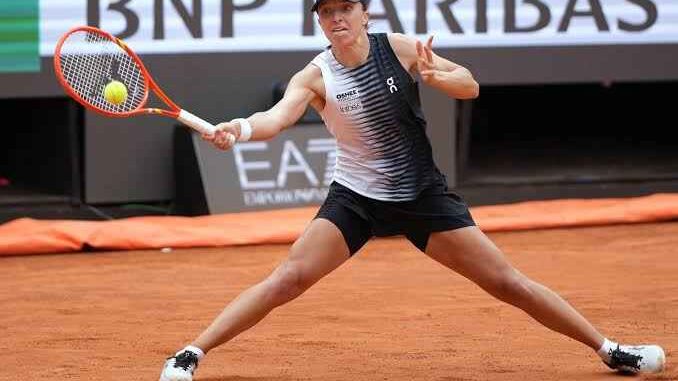
Iga Swiatek advanced in Rome after a physically and mentally demanding match shaped by heavy clay conditions and shifting momentum against former junior doubles partner Caty McNally.
The world No. 3, who arrives with a 15–8 record in 2026 and a 3–2 mark on clay, described a match environment defined by humidity, wind and a slow, heavy ball that required constant adjustment.
Swiatek, a three-time Rome champion in 2021, 2022 and 2024, has not won a title so far this season, but remained focused on process rather than outcomes. The match also followed a disrupted period in Madrid, where illness affected her participation.
The conditions in Rome again became a central factor in her post-match assessment. She repeatedly referenced the difficulty of controlling the ball and maintaining rhythm in wind-affected exchanges, while avoiding framing the performance in emotional or result-driven terms.
“You need to control your emotions”
Swiatek’s description of pressure
management was grounded in repetition and training rather than instinct or natural temperament. She framed emotional control as a developed skill requiring continuous adjustment depending on context and match flow.
She avoided presenting a single mechanism for staying calm, instead highlighting variability between matches and even within the same day. “I mean, what the secret is… you need to kind of work for it and you need to practice it,” the 24-year-old said to Tennis Channel. “You need to control your emotions and control your thoughts and always remember about your goals.”
She added that emotional responses are not uniform across players or situations. “And I think for every player it’s a bit different. And also for every day it’s different because sometimes you get stressed because of one thing, sometimes because of another.”
Swiatek also pointed to tactical adjustment as part of the same process, particularly in matches where momentum shifts under difficult conditions. She described the third set response as a reset rather than a change in approach, focused on execution under pressure.
“We spoke the same language”: Swiatek on early connection with Francisco Roig
The 2026 season has been marked by inconsistency relative to Swiatek’s established clay record, with a 15–8 overall record and no titles ahead of Rome. Despite that, she rejected the idea of defining performance through peak-level comparisons, instead focusing on variability in match outcomes.
She explicitly questioned the concept of a single “best level”, pointing to the unpredictability of results even when performance quality is high. “I try not to look at tennis that way, you know, because what is best level? You can still win tournaments not playing your best or you can play the best tennis possible and lose a match because the girl was better that day.”
Her early work with Francisco Roig continues to develop, with Swiatek describing immediate alignment in communication and goals. She noted that the main adjustment lies in translating training progress into match execution rather than establishing foundational understanding.
The coaching relationship remains in its early phase, with Swiatek highlighting clarity of approach as a key factor. “We spoke the same language in terms of goals, so it’s been easy to work,” she said. “Of course, I’m still adjusting to different coaching styles because I haven’t worked with many coaches.”
“The Foro Italico is always an amazing experience.”
Rome continues to occupy a central position in Swiatek’s clay identity, with three titles in 2021, 2022 and 2024 reinforcing her historical strength at the Foro Italico. She described the tournament as one of the most distinctive events on tour in both competitive and environmental terms.
“It’s one of a kind tournament. You know when someone asks me where to go to watch tennis I say Roland Garros or Rome,” Swiatek said. “You can enjoy your time off court, there are many things to see and do. The Foro Italico is always an amazing experience. It’s shocking how beautiful the site is, so I try to take time to appreciate it.”
Despite the competitive intensity, she stressed the importance of fundamentals on clay. “The most important thing on clay is to fight for everything and grind for every point and make the right decisions and choices.”

Be the first to comment