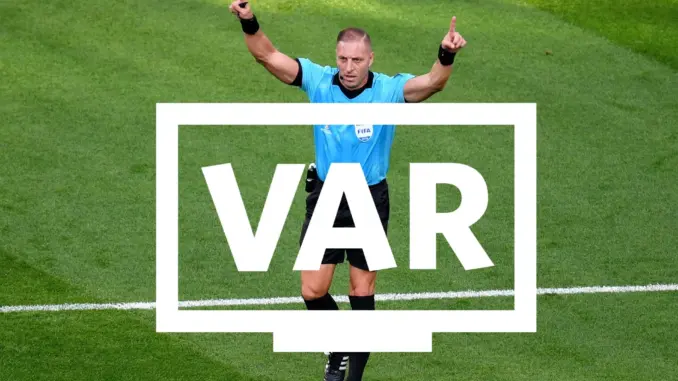
English football has built a position of financial dominance as an entertainment product, yet when it comes to video assistant referees (VAR), it is at complete odds with supporters.
The Premier League introduced VAR in 2019-20 in an attempt to cut out glaring errors, and has been causing arguments ever since.
It is commonplace across elite football, with its remit set to be extended at this summer’s World Cup, but the Football League is safe for now, except when it comes to play-off finals weekend.
Not everyone is delighted.
Hull City’s Sergej Jakirovic is one of a number of Championship managers who would like to see the system in their division

“We can complain about VAR, about how long they check situations but it’s fair,” argues a man who last season coached in the Champions League and Turkish Super Lig, where it is used.
He is by no means alone.
“VAR delivers more correct decisions,” according to the Premier League. “In recent seasons, there have been around 100 correct VAR overturns per season.”
Leeds United fans who saw Paul Tierney turn a blind eye to replays of Luke O’Nien grabbing Pascal Struijk by the neck and shoulders and throwing him to the ground in the penalty area this month might blanch at that, and probably every fanbase in the division can point to its own grievances.
The calamitous refereeing of January’s Aston Villa versus Newcastle United FA Cup tie was as good an advert for VAR as you can get, but what it actually told us was that on that day, certainly, Chris Kavanagh was just nowhere near the standard expected. Neither are too many VARs.
At this summer’s World Cup VARs will decide if referees have wrongly awarded a corner or a second yellow card – two areas they are currently told to butt out of.
Apparently the corner checks are designed to be completed during the “natural pause” whilst kicks are set up. Anyone who has seen Stockley Park faff about might be sceptical.

In 2024, Wolverhampton Wanderers proposed scrapping VAR in the Premier League, and their 19 fellow clubs all voted against.
Both would be nice but what matters more – getting more decisions right or pleasing the people who pay to watch?
Because the evidence of a recent survey by the Football Supporters Association suggests VAR is certainly not doing the latter.
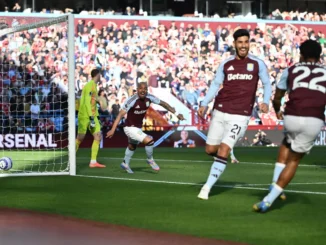
Of just under 8,000 Premier League fans – spread across all 20 clubs and with more than half attending 15 or more games a season – three quarters were against VAR. Ninety per cent disagreed it had improved the matchday experience, 91 per cent complained it has harmed the spontaneity of goal celebrations.
The proportion who disagreed it improved the spectacle for TV viewers – the demographic modern football wrongly seems most concerned with – was 94 per cent.
“People are annoyed about the time that it takes, annoyed about the accuracy and annoyed about the (reduced) spontaneity,” said Thomas Concannon, the FSA’s Premier League network manager.
“It does take away from what football is meant to be and what those special moments are about.”
In a sport which markets itself on emotions, that ought to matter.
Seventy-two per cent – disagree VAR has made refereeing more accurate, and 74 per cent more think the reason for its decisions is not made clear enough. Eighty-six per cent are worried about it being expanding, with 72 per cent opposing the guidelines on corners, 52 pet cent opposed to the second yellow card tweak.
This in not some Luddite revolt.
Ninety-three per cent support goalline technology – provided it is switched on, Sheffield United fans who remember their 2020 game at Aston Villa might have added, had they been asked.
Black-and-white technology with instant results – like a run-out call in cricket, a line call in tennis or a decision on whether a try was grounded in either rugby code – is one thing. But too much of the VAR’s work is subjective – and ponderous.
Players are ruled offside by toenails using technology whose margin for error runs into tens of centimetres. It has been calculated a player running at top speed can move 20cm between the frames of a television shot. You would not know it from the crosshairs drawn at Stockley Park.
“Premier League research indicates fans are largely in favour of keeping VAR, but improving the way it is used,” counters the top division, but it does not ring true with this correspondent’s experience. Chants of “F*** VAR” are common.
So a bigger sample size of actual match-going fans would be welcome, but whilst the numbers might change, it is hard to see the mood of the FSA’s findings shifting.
There are (debatable) arguments to be made about accuracy and fairness, but when football is more money-driven than ever, should the customer not be king?


Be the first to comment